The SKA Observatory has released a book detailing what scientists want to do with the SKA

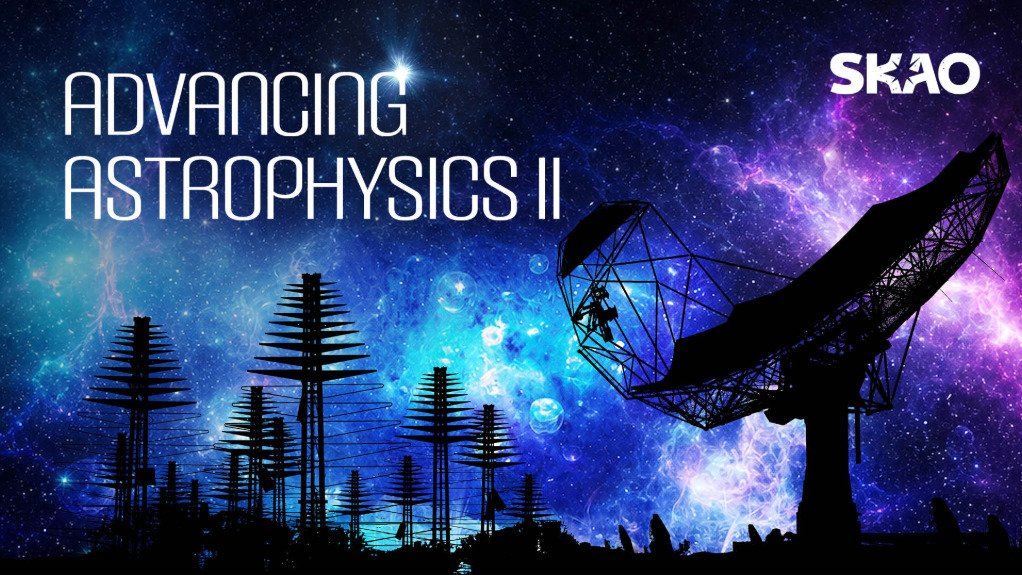


With both elements of the international Square Kilometre Array (SKA) under construction, the organisation responsible for creating and operating it, the SKA Observatory (SKAO), has released a book, “Advancing Astrophysics II’, that highlights the huge range of research that the SKA will allow. (A previous book had been published by the SKAO’s predecessor, the SKA Organisation, in 2015.)
South Africa is hosting the SKA-Mid instrument, which will eventually have 197 dishes, incorporating the country’s own, existing, MeerKAT array, while Australia is hosting the SKA-Low instrument, which will eventually comprise 131 072 antennas. The SKA-Low released its first test image, captured using 1 024 antennas, in March last year. The SKA-Mid is expected to do the same later this year, using four dishes. The SKAO head office is hosted by the UK.
The new book contains 221 peer-reviewed papers, produced by more than 1 500 scientists in 51 countries. (The SKAO has 14 full member countries.) These papers cover all the areas of scientific research that the SKA instruments will undertake. They are grouped into six sections, entitled the Sun, Earth and planets, the formation and evolution of stars, from the Milky Way to distant galaxies, the cosmos, the extreme universe, and, methods and techniques.
“The science cases presented here will shape the SKAO’s scientific strategy as the telescope arrays grow towards completion, and inform priorities for upgrades and the continued evolution of the Observatory’s capabilities in the coming years,” highlights SKAO scientific services head Dr Anna Bonaldi. “Our science explores the Universe across every scale and physical regime, leveraging the SKA telescopes’ transformational sensitivity, survey speed, and imaging capabilities, together with powerful synergies across the world’s leading facilities. The number of submissions also makes clear that the science community’s enthusiasm is only growing as we get closer to the first SKAO science.”
Of the more than 1 500 contributors to the book, the biggest single group comes from Italy, amounting to 14.9% of the total, followed by the UK (10.4%), Germany (8.7%) and China (8.6%). All four are SKAO members. Next comes the US, not a member of the SKAO, with 8% of the contributors. Then comes India (7.1%), Australia (6.9%), France (5.2%), Spain (4.5%) and the Netherlands (3.8%); all five are SKAO members. Non-member Japan accounted for 3.3% of contributors, followed by SKAO members South Africa (3.1%), Canada (1.9%) and Switzerland (1.5%), non-member South Korea (1.4%), and member countries Sweden (1.1%) and Portugal (1%).
There are also contributors from another 35 countries, although in every case amounting to less than 1% of the total number of contributors. These countries are Argentina, Austria, Belgium, Brazil, Bulgaria, Chile, “Chinese Taipei” (Taiwan), Croatia, Cyprus, Czechia, Denmark, Egypt, Estonia, Finland, Ghana, Greece, Hungary, Iran, Ireland, Israel, Kenya, Luxembourg, Mexico, Micronesia, New Zealand, Norway, Pakistan, Poland, Romania, Russia, Türkiye, the United Arab Emirates, Vietnam and Zambia. Note that four of them are African countries.
“This collection of papers shows not only the dazzling array of science our community will seek to address with the SKA telescopes when complete, but also how the community has grown in size and ambition since our last science book in 2015, with hundreds more contributors this time,” points out SKAO Chief Scientist Prof Naomi McClure-Griffiths.
Article Enquiry
Email Article
Save Article
Feedback
To advertise email advertising@creamermedia.co.za or click here
Projects

Latest Multimedia

Latest News
Showroom
Supplier & Distributor of the Widest Range of Accurate & Easy-to-Use Alcohol Breathalysers
VISIT SHOWROOM
Rio Carb is an OEM (Original Equipment Manufacturer) of R-C700 Chromium Carbide (CrC) alloy clad wear plates and pipes used for heavy materials...
VISIT SHOWROOM

Press Office
Announcements
What's On
Subscribe to improve your user experience...
Option 1 (equivalent of R125 a month):
Receive a weekly copy of Creamer Media's Engineering News & Mining Weekly magazine
(print copy for those in South Africa and e-magazine for those outside of South Africa)
Receive daily email newsletters
Access to full search results
Access archive of magazine back copies
Access to Projects in Progress
Access to ONE Research Report of your choice in PDF format
Option 2 (equivalent of R375 a month):
All benefits from Option 1
PLUS
Access to Creamer Media's Research Channel Africa for ALL Research Reports, in PDF format, on various industrial and mining sectors
including Electricity; Water; Energy Transition; Hydrogen; Roads, Rail and Ports; Coal; Gold; Platinum; Battery Metals; etc.
Already a subscriber?
Forgotten your password?
Receive weekly copy of Creamer Media's Engineering News & Mining Weekly magazine (print copy for those in South Africa and e-magazine for those outside of South Africa)
➕
Recieve daily email newsletters
➕
Access to full search results
➕
Access archive of magazine back copies
➕
Access to Projects in Progress
➕
Access to ONE Research Report of your choice in PDF format
RESEARCH CHANNEL AFRICA
R4500 (equivalent of R375 a month)
SUBSCRIBEAll benefits from Option 1
➕
Access to Creamer Media's Research Channel Africa for ALL Research Reports on various industrial and mining sectors, in PDF format, including on:
Electricity
➕
Water
➕
Energy Transition
➕
Hydrogen
➕
Roads, Rail and Ports
➕
Coal
➕
Gold
➕
Platinum
➕
Battery Metals
➕
etc.
Receive all benefits from Option 1 or Option 2 delivered to numerous people at your company
➕
Multiple User names and Passwords for simultaneous log-ins
➕
Intranet integration access to all in your organisation